PCOS: Why it’s Never “Just a Hormone Problem”
Polycystic Ovary Syndrome, or PCOS, is one of the most common endocrine conditions in women*. Despite this, it is still frequently misunderstood, underexplained, and often reduced to a purely reproductive or cosmetic issue.
*the term “women” is used here and throughout referring generically to people assigned female at birth (AFAB).
DISCLAIMER: THIS BLOG POST DOES NOT PROVIDE MEDICAL ADVICE
The information in this blog post, including but not limited to the text, graphics and images, are for educational and informational purposes only. None of the material within this blog post is intended to substitute medical advice, diagnosis or treatment. Always seek the advice of a qualified medical professional such as your doctor when you have concerns or questions.
PCOS can present with irregular or absent menstrual cycles, acne, androgen-related hair loss, increased body or facial hair, metabolic changes, and difficulties with ovulation or fertility. Importantly, not all individuals experience the same symptoms, and symptom severity can vary significantly over time.
What links these seemingly diverse features is not a single hormone abnormality, but a broader disruption involving hormonal regulation, metabolic signalling, and tissue-specific responses. To understand PCOS properly, it is necessary to look beyond the ovaries and consider the condition as systemic.
PCOS as a Systemic Endocrine and Metabolic Condition
Although PCOS is diagnosed using reproductive criteria, its effects extend across multiple physiological systems. These include:
the endocrine system, involving insulin, androgens, and gonadotropins
the metabolic system, particularly glucose and lipid metabolism
the skin and hair follicles, which are sensitive to androgen signalling
ovulatory function and progesterone production
This multisystem involvement explains why PCOS rarely presents uniformly and why management strategies that focus on only one symptom often fail to address the underlying drivers.
The Role of Insulin in PCOS

One of the most consistently observed features of PCOS is insulin resistance. Insulin resistance refers to a reduced cellular response to insulin, leading the pancreas to compensate by producing higher circulating insulin levels.
Importantly, insulin resistance in PCOS is not restricted to individuals with higher body weight. A substantial proportion of lean individuals with PCOS also exhibit impaired insulin signalling, suggesting that insulin resistance is not merely a consequence of adiposity but an intrinsic feature of the condition in many cases.
Insulin functions not only as a regulator of glucose uptake but also as a signalling molecule that influences ovarian steroidogenesis, hepatic protein synthesis, and inflammatory pathways. Chronic hyperinsulinaemia, therefore, has consequences far beyond blood sugar regulation.
Insulin, Androgens, and Hormonal Dysregulation
Elevated insulin levels contribute to androgen excess through several mechanisms.
At the ovarian level, insulin directly stimulates theca cells to increase androgen production, particularly testosterone. This effect can occur independently of luteinising hormone and amplifies androgen output.
At the hepatic level, insulin suppresses the production of sex hormone-binding globulin, or SHBG. SHBG binds circulating testosterone, limiting its biological activity. Reduced SHBG results in a higher proportion of free, biologically active testosterone.
The combined effect is functional hyperandrogenism, which may not always be apparent through total testosterone measurements alone.
Tissue-Specific Effects on Skin and Hair
Testosterone can be converted locally into dihydrotestosterone, or DHT, by the enzyme 5-alpha-reductase. DHT has a higher affinity for androgen receptors and exerts strong effects on androgen-sensitive tissues.
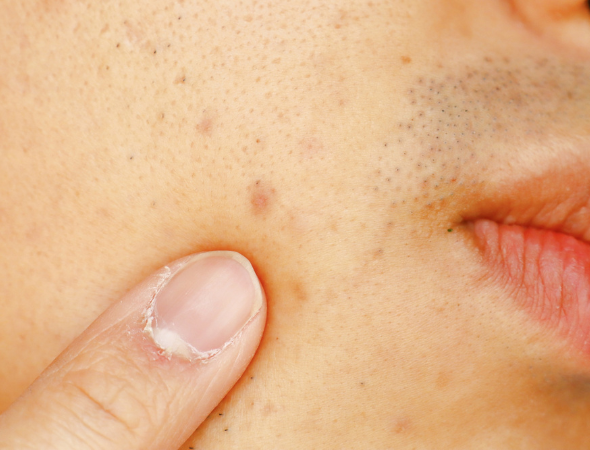
In the skin and hair follicles, increased DHT activity can lead to:
increased sebum production and altered lipid composition
follicular hyperkeratinisation
inflammatory acne lesions
miniaturisation of scalp hair follicles in androgen-sensitive regions
These effects help explain why acne, oily skin, and androgen-related hair loss are common features of PCOS, even in individuals without markedly elevated serum androgen levels.
Effects on Ovulation and the Menstrual Cycle
Insulin resistance and androgen excess also disrupt normal ovulatory signalling. Elevated insulin and androgens interfere with follicular maturation and can prevent the selection of a dominant follicle.
When ovulation does not occur regularly, progesterone production remains insufficient. Low or absent progesterone contributes to irregular cycles, prolonged follicular phases, breakthrough bleeding, and reduced cycle predictability.
Over time, chronic anovulation can increase the risk of endometrial hyperplasia, highlighting the importance of addressing ovulatory dysfunction beyond fertility considerations alone.
Why PCOS Is Often Diagnosed Late
Standard metabolic screening often relies on fasting glucose or HbA1c measurements. These markers can remain within reference ranges despite significantly elevated insulin levels.
As a result, insulin resistance may go undetected for years while symptoms progress. This contributes to delayed diagnosis and can lead to frustration when individuals are told that test results appear normal despite ongoing symptoms.
Early recognition of insulin resistance and androgen dysregulation allows for more proactive management and may reduce the risk of longer-term metabolic complications.
Long-Term Health Considerations
PCOS is associated with an increased risk of type 2 diabetes, metabolic syndrome, dyslipidaemia, and cardiovascular disease. These risks are influenced by insulin resistance, chronic low-grade inflammation, and hormonal dysregulation rather than reproductive features alone.
Viewing PCOS as a lifelong metabolic and endocrine condition rather than a transient reproductive disorder is essential for appropriate long-term care.
Why This Perspective Matters
PCOS cannot be understood through a single hormone, symptom, or laboratory value. It reflects a complex interaction between metabolic signalling, endocrine regulation, and tissue-specific sensitivity to hormones.
A clearer understanding of these mechanisms helps explain why symptoms cluster, why experiences vary widely, and why supportive strategies must address the system as a whole rather than isolated outcomes.
References & Further Reading
Want to read more about PCOS?
Check out this blog post: Polycystic Ovary Syndrome (PCOS): An Overview